

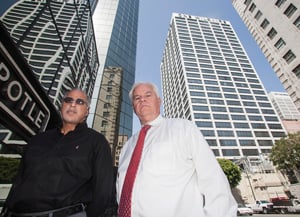
U.S. Colo occupies two spaces on the fourth floor of downtown L.A.’s One Wilshire building. Neither is larger than a pingpong table. One measures only 4 feet by 4 feet – and rents for about $5,400 a month. That’s more than 100 times the average rent downtown on a square-foot basis.
It’s the premium one has to pay to be near the action at One Wilshire, which behind its inconspicuous façade houses the biggest telecommunications hub in the Western United States.
The electronic activity is greatest in the huge fourth-floor Meet Me Room, where hundreds of telecom and Internet companies pay top dollar to plug directly into each other’s networks. There, rows of component-filled cages and cabinets – just enough space to set up connection equipment – are stacked next to each other, with a labyrinth of cables running overhead. It’s one of the world’s densest Internet exchanges.
But the growth of the telecommunications industry has led to new and rising fees for a seat at this electronic table, hurting smaller players like U.S. Colo, a provider of Internet connections for businesses. Friction between those companies and Denver’s CoreSite Realty Corp., which leases and operates the fourth floor, has spilled over into a legal fight.
“It’s becoming egregious,” said Max McCombs, U.S. Colo’s co-founder, who explained that his company, to an extent, is stuck; it needs to be next to the many networks it plugs into. “People say you can go somewhere else, but there’s a difference between a telecommunications company relocating than, say, a law office.”
McCombs, who co-founded the company with Navroz Haji, complained that in addition to the sky-high rent, CoreSite is charging hundreds of thousands in fees for physical connections that were once free – a heavy burden for his company, which has annual revenue of less than $10 million.
Experts said the plug-in price is going up across the industry. As data center operators like CoreSite, backed by institutional investors, have become publicly traded, they have also become more aggressive in monetizing telecommunications exchanges. That’s a break from the past when they simply charged rent and for power.
“When this was in its infancy back in the late ’90s and early part of this century, it was more of a real estate play,” said David Lambert, an attorney who reviewed the case for the Business Journal. “Now they’re looking at it as a big source of revenue.”
The value of the exchanges is attracting real estate investors: Last year, the 660,000-square-foot, 30-story One Wilshire was sold to Menlo Park private equity firm GI Partners for $437.5 million, a downtown L.A. record. By comparison, the iconic 1.4 million-square-foot, 72-story U.S. Bank Tower – more than twice as big – last year sold for $70 million less.
CoreSite declined to comment through an attorney.
Building history
Though its actual address is 624 S. Grand Ave., One Wilshire is so named because it sits at the eastern end of Wilshire Boulevard. Built in 1966, it mostly housed law offices for its first few decades and did not become an important telecommunications building until the deregulation of the industry in the 1980s.
The breakup of AT&T led to the rise of such competitors as Sprint and MCI, which initially needed access to AT&T’s switching center on Grand. AT&T’s rivals took up space in the nearby One Wilshire building, installing microwave antennas on the roof to relay telephone signals. Eventually, they began to bypass AT&T and connected directly to each other at One Wilshire.
The emergence of the Internet in the 1990s furthered the need for telecommunications hubs. One Wilshire, which had built up a critical mass of telecom companies and was situated near newly built transpacific cables from Asia, became a magnet for carriers. Today, it is one of the three busiest telecommunications hubs in the world.
To understand what happens inside the building, it’s useful to think of the Internet as a network of networks. When you connect to an Internet service provider – say, Time Warner Cable or Verizon – you are connecting your computer to that provider’s network. The provider in turn connects its network to others. When a home computer in Los Angeles accesses information on, say, a Chinese website, the information might be sent from servers housed in a data center in China to a Chinese Internet provider, which sends it through one of several cables that runs under the Pacific Ocean. The information is handed off to other carriers on this side of the Pacific, and might bounce around several connection points, including One Wilshire, before being sent to your computer.
Nodes like One Wilshire are where carriers can meet to exchange data. Most of the exchanges at One Wilshire happen in the Meet Me Room.
Making connections
Tenants in the Meet Me Room can connect to about 185 telecom carriers, including Verizon and China Telecom, as well as media and entertainment companies, cloud computing companies and social networking sites. Some tenants also keep bulkier equipment in rooms on other floors in the building or in other buildings nearby.
The density of connections makes the building vital to global communications. Should the building be suddenly destroyed by an accident or an attack, it would severely disrupt – although not shut down – Internet and phone services in the Western United States, said John Savageau, telecommunications consultant and former CoreSite chief technology officer.
Outside of the fourth floor, the rest of the building houses mostly additional telecommunications-related equipment. There is a scattering of law offices and other traditional offices.
Some telecom tenants install their own air-conditioning systems to combat the huge amounts of heat given off by their equipment. All of this requires a lot of power: Savageau estimates the building can draw up to 30 megawatts, enough to power 25,000 homes. Thousands of gallons of diesel fuel are stored inside the building to power backup generators in case of an outage.
In addition to the carriers themselves, One Wilshire is also a prime location for Internet companies looking to make connections.
Companies can rent space in the building directly or they can go through co-location companies like U.S. Colo. Headquartered downtown, U.S. Colo caters largely to startups and small companies that can pay to use its equipment and connect to telecom carriers through its position on the fourth floor.
U.S. Colo subleases two cages, of 16 and 24 square feet, from CoreSite, which in turn leases the floor from building owner GI Partners. U.S. Colo also keeps equipment in a building across the street that links to One Wilshire through underground cables. The company also uses two suites on other floors in One Wilshire.
McCombs said the rent for the two fourth-floor cages is $339 a square foot a month, which comes out to about $160,000 a year. By comparison, the average Class A asking rent in a downtown office building was $3.15 per square foot in the first quarter of this year, according to Jones Lang LaSalle Inc. It adds up to a lot of money: CoreSite projected $24 million in rent from the 160,000 square feet it leases at One Wilshire, according to its most recent annual filing.
Rising costs
McCombs isn’t happy about the high rents, but it’s the hundreds of thousands of dollars in new annual plug-in fees that have drawn him into a court battle.
A tenant in One Wilshire’s fourth floor might have hundreds of connections to other networks. The cost of connecting used to be free, but McCombs said that at some point in the last five years, CoreSite began charging tenants for each plug-in. Rates spiked further when CoreSite went public in 2010. By 2012, it was charging $275 per month for each connection made, costing U.S. Colo $23,000 a month.
“It’s like a toll booth to access someone else’s network,” McCombs said.
Matthew Lagoe, manager at Downtown Colo, which rents two cabinets and a cage on the fourth floor of One Wilshire, said monthly fees had risen to $350 per connection, but tenants are forced to stick it out because they’ve already invested money in installing equipment – and because One Wilshire remains the best game in town.
“Everybody’s complaining,” he said, but “a lot of carriers, especially in the international market, only know of One Wilshire, so they self-perpetuate the cycle.”
Public filings show CoreSite had interconnection service revenue of $29 million across its 16 facilities last year, up 34 percent from the year before and more than six times higher than in 2010.
U.S. Colo sued CoreSite over the fees last month in Los Angeles Superior Court. It claims CoreSite is exploiting a monopolistic hold on the market, and that the fees are in violation of previous agreements between U.S. Colo and a previous building owner.
Lambert, the attorney who reviewed the case for the Business Journal, said the connection fees were fairly typical for the industry, which is looking to maximize revenue as companies go public. Carrollton, Texas, data center operator CyrusOne had its initial public offering last year, while others such as IO Data Centers and Quality Technology Services have filed for IPOs. Equinix, one of CoreSite’s largest rivals, went public back in 2000.
That, said Lambert, puts pressure on the companies to keep investors happy by increasing fee revenue.
Savageau said the fees were not going to put a dent into large carriers like AT&T and Verizon, but would disproportionately hurt smaller companies and startups. Indeed, McCombs said the fees had hindered his company’s expansion plans and were threatening to make its operations at One Wilshire unprofitable.
But Savageau added that the conflicts eventually could cause alternative telecom hubs to emerge in the region, in much the same way One Wilshire rose as an alternative to AT&T. There are now about a dozen similar hubs in Los Angeles, but nothing on a comparable scale.
“If they raise prices to what the market will bear, I can’t say it’s a bad thing at all,” he said. “If that creates barriers for small entrepreneurial startups to operate in, now there’s a great opportunity to create a bypass for the One Wilshire building.”
