
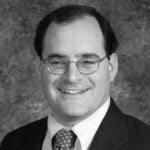

George Joseph, a World War II bomber pilot who went on to found Mid-Wilshire-based insurance company Mercury General Corp. and in his final years was the world’s oldest billionaire, died on Aug. 26. He was 104.
His death was announced in a post on Mercury General’s website. No cause of death was given.
Joseph established Mercury in 1962 as an auto insurance company. He served as chief executive for 45 years, helping transform the company into a major multi-line property and casualty insurer. After stepping down as chief executive in 2006, he remained active in the company for another decade, coming into the office regularly well into his 90s.
For decades, Joseph owned a third of the firm’s common shares. At the time of his death, those 19 million-plus shares were worth more than $2 billion. That, plus a constantly growing money pool of share dividend payouts, made him a regular on the Business Journal’s annual list of Wealthiest Angelenos. Last year, his net worth of $3.3 billion placed him at No. 28.
Upon Joseph’s death, his shares transferred to his second wife, Vicky, who is in her mid-70s. His son Victor, one of his five children, has since 2024 served as president and chief operating officer of Mercury General.
World War II bomber missions
Born on Sept. 11, 1921, Joseph was the son of Lebanese immigrants. He was raised in Beckley, West Virginia, during the Great Depression. In 1941, he volunteered for military service and served as a B-17 navigator during World War II, flying 50 missions. He later attended Harvard University on the GI Bill and graduated in 1949 with a degree in math and physics.
After the war, like many veterans, he settled in Los Angeles and started working as an actuary for Occidental Life Insurance Co. He eventually became a sales agent for Occidental, where many of his customers started asking him about auto and home insurance. After unsuccessfully trying to convince Occidental executives to allow its agents to offer a full line of coverage, he began packaging auto and home insurance policies from another company with the Occidental policies he was already selling.
Launching Mercury
As he sold auto insurance policies, Joseph realized rates were based on a narrow band of factors, resulting in the same rates assigned to customers with vastly different risk profiles. He then decided to found a new company that used a wider range of factors to more fairly calculate rates.
“We called our company Mercury because I wanted us to be fast and nimble, just like the Roman god of business and merchants,” Joseph subsequently said.
The company started with six employees and 90 agents. Over the decades, it grew into the largest independent agency writer of private passenger auto insurance in California. The company went public in 1985 and then expanded outside the state and into residential and other lines of business. Mercury’s written premiums grew to just over $1 billion in 1997 and $3 billion in 2006.
“George Joseph built Mercury on the belief that customers deserved quality insurance, fair pricing, and personal service,” current Chief Executive Gabriel Tirador said in the company’s post. “He was an innovative leader who created more flexible, quality insurance products that served a larger share of society.”
Ballot box fights
After stepping down as chief executive and handing the reins to Tirador in 2006, Joseph remained active, especially on the policy front. He regarded the landmark Proposition 103 reform package passed by California voters in 1988 as an existential threat to Mercury’s business model. Besides requiring rate increases to be approved by an elected insurance commissioner, that measure also banned the practice of allowing drivers to keep “good driver” discounts when switching auto insurance carriers. Mercury had relied on this practice to grow its market share.
Joseph made two attempts to pass state ballot measures repealing this ban in 2010 and 2012; in each case, he spent $16 million of his own money – by far the largest source of funding. But both attempts were rejected by voters: the 2010 measure lost by a 52% to 48% margin, while the second lost by a larger 55% to 45% margin.
After that second defeat at the ballot box, Joseph, then 91, stepped back from public life and a few years later, stopped coming into Mercury’s mid-Wilshire office. He lived out his final decade in relative obscurity at his Hancock Park residence.
In 2022, Forbes named Joseph, who was then 101, as the world’s oldest billionaire. With his passing, that mantle has now gone to the 102-year-old Robert Kuok of Malaysia, whose fortune includes Shangri-La Hotels and Resorts.
