

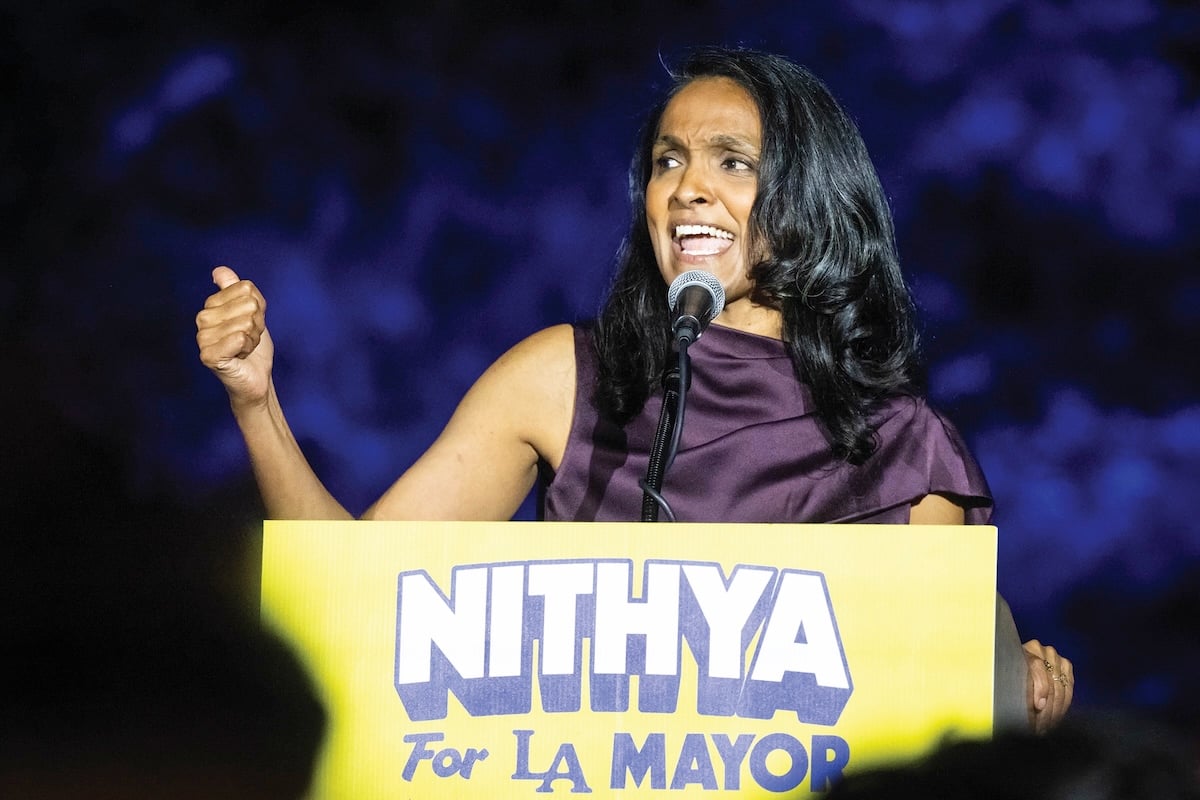
At first glance, the prospect of Nithya Raman as L.A.’s first Democratic Socialist may- or taking office next month would seem likely to invoke deep concern from the business community. And not surprisingly, most of the city’s business establishment supported her opponent, incumbent
Mayor Karen Bass, in the recently concluded election campaign.
But several key aspects of Raman’s campaign platform and her display of a fiscally pragmatic streak during her six years on the Los Angeles City Council may offer some hope that the forthcoming Raman administration will not be the disaster that some L.A. businesspeople feared.
Across the board, she has promised a more efficient city permitting system. For L.A.’s signature film and television industry, she’s pledged to speed up permitting and lower fees, as well as improve coordination among local jurisdictions. (See more on page 12.) On the real estate front, she has promised to reduce barriers to construction of affordable housing.
For small businesses, she again promised faster permit turnarounds.
And for all businesses, she promised a more responsive and flexible approach from the Los Angeles Department of Water and Power.
“One thing that people don’t fully realize with Nithya Raman is that being a Democratic Socialist calls for more efficiency and competence across the board,” said Fernando Guerra, a professor of political science at Loyola Marymount University in Westchester who also directs the university’s Center for the Study of Los Angeles.
But Guerra said business owners and investors will be watching closely to see how Raman tackles the city’s major issues: homelessness, the lack of affordable housing, public safety and an increasingly problematic physical infrastructure. They will also be watching to see how competently the city and the LA 28 Olympic Organizing Committee host and stage the 2028 Summer Olympic and Paralympic Games.
“Making the city work and feel better will in turn make the city more business-friendly and make people more willing to invest in the city,” he said.
Indeed, that was the message that L.A.’s largest business group conveyed once the election was called for Raman on Nov. 5.
“Our city has important work ahead: addressing housing and public safety, supporting local businesses, strengthening our neighborhoods, creating jobs, and keeping Los Angeles competitive,” Maria Salinas, chief executive of the Los Angeles Area Chamber of Commerce, said in a statement. The chamber endorsed incumbent Bass in the election.
“As Los Angeles prepares to welcome the world, we must get the basics right here at home,” Salinas added. “That means a city where businesses can grow, residents can find opportunity, and the economy works for all Angelenos.”
With all this in mind, the Business Journal examined some key areas and industries, Mayor-Elect Raman’s agenda for those sectors and what key players in those industries hope to see from a Raman administration.
Infrastructure and Olympics preparedness
Mayor-Elect Raman campaigned on ambitious plans to improve L.A.’s infrastructure. She promised to speed up the filling of potholes and repowering thousands of streetlights. A bicyclist herself, Raman promised to add protected bike lanes. She also wants to add more dedicated express bus lanes throughout the city.
And Raman has said she will seek to fast-track rail projects now scheduled for completion decades from now, such as the Metro K Line northern extension from the Crenshaw station on the Metro E Line through West Hollywood and into the heart of Hollywood, which isn’t slated for completion until at least 2047.
Of course, following through on all these promises will require lots of money, which could prove a huge challenge.
“The biggest problem that the mayor is going to confront is the financial condition and budget of the city,” said Zev Yaroslavsky, director of the Los Angeles Initiative at the UCLA Luskin School of Public Affairs. Yaroslavsky served 20 years on the Los Angeles City Council, followed by another 20 years on the Los Angeles County Board of Supervisors.
Yaroslavsky said in order to make progress on these infrastructure-related campaign promises, Raman will have to step on some toes. He pointed specifically to expensive contracts that the city has negotiated with many of the unions representing its employees.
Fast-tracking major rail projects could encounter another set of funding challenges, ac- cording to Marlon Boarnet, professor at the USC Sol Price School of Public Policy and director of the Metrans Transportation Consortium, a joint partnership between USC and Cal State Long Beach.
“Metro projects are programmed decades out based on the sales tax revenues coming in over long periods of time,” Boarnet said. “If you start fast-tracking some of these projects, then you have to find the additional revenue to make that possible.”
And right out of the gate, Raman will confront what has become one of the most troubled infrastructure projects in recent city history: the $3 billion-plus Skyline automated people mover project at Los Angeles International Airport. While construction is virtually complete, the project has become bogged down in a bitter dispute between Los Angeles World Airports – the city agency whose board members are appointed by the mayor – and the contractor, known as LAX Integrated Express Solutions, or LINXS. One key point of recent contention has been the inability to complete a power connection agreement with the Los Angeles Department of Water and Power.
With the opening date now pushed back to at least next February, the project faces the prospect of a technical default on Dec. 8, exactly one week before Raman takes office.
In the closing days of the campaign, Raman said that as mayor, she would convene a meeting between LAWA, LINXS and representatives from the Los Angeles Department of Water and Power to get the connection agreement completed.
Meanwhile, Raman also promised significant changes at the LADWP, including improving billing practices and speeding up water and power connections for new residential and business customers. Many restaurants and other startups in the city have long complained about delays and complexity in getting connected to the LADWP.
Five years ago, newly elected Councilwoman Raman voted against the city’s contract with the LA28 Olympic Organizing Committee that has the city covering LA28 budget cost over- runs. Now, as the incoming mayor, she’s about to lead the city’s Olympics preparedness efforts.
Raman’s initial opposition could end up serving her well, according to Yaroslavsky, who was on the Los Angeles City Council before and during the 1984 Olympics.
“With the city on the hook for any cost overruns, Raman’s skepticism is a good thing,” Yaroslavsky said. “She will no doubt demand increased transparency from LA28 and assurances that the Olympics are on an at-least break-even course,” he added.
In her capacity as a member of Metro’s board, Raman will also have to do her part to ensure key transit projects like the D Line Extension to Westwood are completed on time, he added. The UCLA campus and adjacent parts of Westwood will once again host the Olympic Village for athletes.
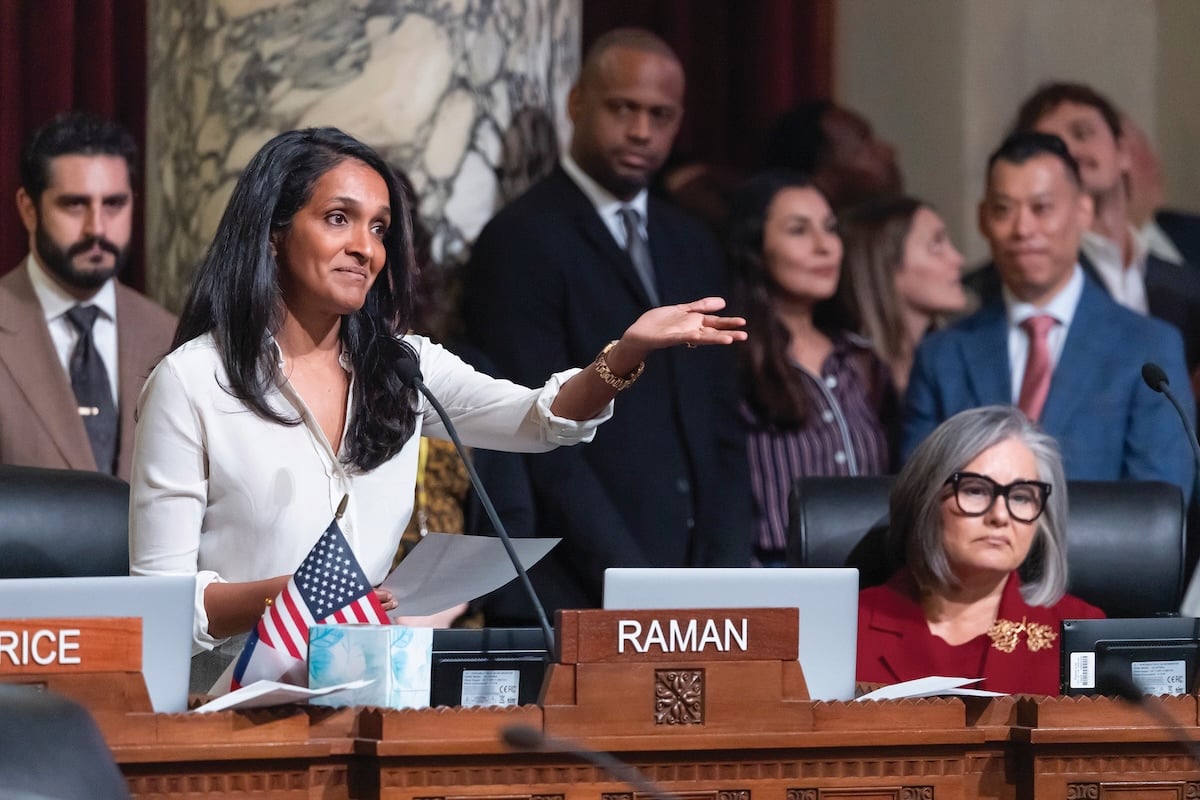
Nithya Raman speaks at the
Nov. 10 city council meeting. (Myung J. Chun / Los Angeles Times via Getty Images)
Banking and finance
The mayor-elect could make her mark on L.A.’s lending scene by furthering an ongoing effort to form a city-owned bank.
As a city councilmember, Raman aligned with a decade-long campaign by Public Bank L.A. to create a nonprofit, tax-exempt alternative to private banks that finances affordable housing, public infrastructure and disaster resilience. In June 2023, the mayor-elect called public banking an “opportunity to offer banking services to underbanked and unbanked Angelenos” and “sidestep predatory practices and excessive fees.”
“I think what’s really exciting is that we have a potential to fill the gaps that our reliance on commercial banking has left us with,” Raman said. “I think those gaps are really felt most keenly for communities of color, and for working class people.”
L.A.’s public banking movement stands on a camp of proponents that include unions, small businesses, and advocates vocal on housing, environmental, racial and immigrant issues. They say a city-owned bank could use deposits to reinvest in projects for the public’s benefit while replacing high-interest loans from private banks with low-cost credit.
Progress on bringing that vision to life has been stop-and-go. More than three years have passed since City Council moved to identify roughly half a million dollars to fund a public bank feasibility study championed by Raman.
The city’s 2024-2025 budget included funds for the study, but the go-ahead was swiftly reversed after a financial status report detailing budget pressures sent the allocation back to city reserves.
The council, still yet to scrounge up the money, voted again last month to seek funding for the stalled effort to analyze the policy and economics behind forming a public bank.
So far, seven councilmembers, including Raman, have put up $15,000 from their discretionary funds. That leaves a $355,000 hole the council will need to fill before it can get consultants to work.
Real estate
Raman has been an unlikely ally to real estate on a prominent issue: the so-called mansion tax.
As a Councilmember, Raman introduced a motion in January to exempt new multifamily, commercial and mixed-use projects from Measure ULA’s transfer tax for 15 years. But faced with opposition from labor leaders and community groups that back the tax, the City Council declined to take it up.
While Raman’s campaign platform didn’t mention ULA, she promised to triple annual housing construction and impose a permitting “shot clock” of 60 days for zoning-compliant projects and 120 days for discretionary ones.
Still, industry leaders are hopeful she’ll take another shot at reforming Measure ULA after taking office next month.
Mott Smith, board chair of the Council of Infill Builders, a state lobbying group for housing developers, described Raman as “a technocrat who actually wants City Hall and business to work together.”
“I think we could see a more builder-friendly City Hall under Mayor Raman than we’ve seen in decades,” Smith said, warning that easier permits would not be enough. “Unless L.A. stops treating landlords like the enemy and we fix Measure ULA, we will fail to come anywhere close to meeting our housing goals.”
Landlords are warier. Raman’s campaign site lists among her accomplishments a cut in the annual cap on rent increases for rent-stabilized units from 3-8% to 1-4%, just-cause eviction protections for all rental units and a ban on evictions over debts smaller than one month’s fair-market rent.
That platform is “bordering on communist,” said Dan Yukelson, executive director of the Apartment Association of Greater Los Angeles, a landlord group. Yukelson said Raman “made things far worse” for homelessness as chair of the council’s housing and homelessness committee.
“In real estate, people are looking for exit ramps,” Yukelson said. He warned that mom- and-pop owners squeezed by insurance, utility and eviction costs will sell to developers who replace older, naturally affordable buildings with luxury units or condos.
“I hope she’ll give people in the housing business a chance to survive,” he said. Mike Condon, executive vice chair at Cushman & Wakefield, said L.A. “needed a change” after being “in a rut since COVID.” He called ULA “a horrible policy not well thought out.”
Condon, whose team is selling studio and production properties, added that he hopes Ra- man will be “more responsive to replanting the seeds of TV production in LA.” Her platform calls for an L.A. Film Office in the mayor’s office, faster film permits and lower fees for small productions.
Newmark’s Kevin Shannon, who is co-head of capital markets, noted that democratic socialism’s current popularity goes beyond here, with mayoral candidates clinching victories in New York City, Washington D.C. and Seattle over the past two years.
Closer to home, Shannon said reining in Measure ULA should be the city’s priority. He suggested a transfer tax rate of around 1.5% to balance revenue and deal volume. In the meantime, he said, capital will continue to “play around the city limit edges,” landing in El Segundo and other South Bay cities without the tax.
“If she could change that, that would be a great start,” Shannon said. “I remain optimistic until proven otherwise. Hopefully she understands what needs to be done.”
Staff reporters Christina Chkarboul and Abigail Nehring contributed to this report.

