

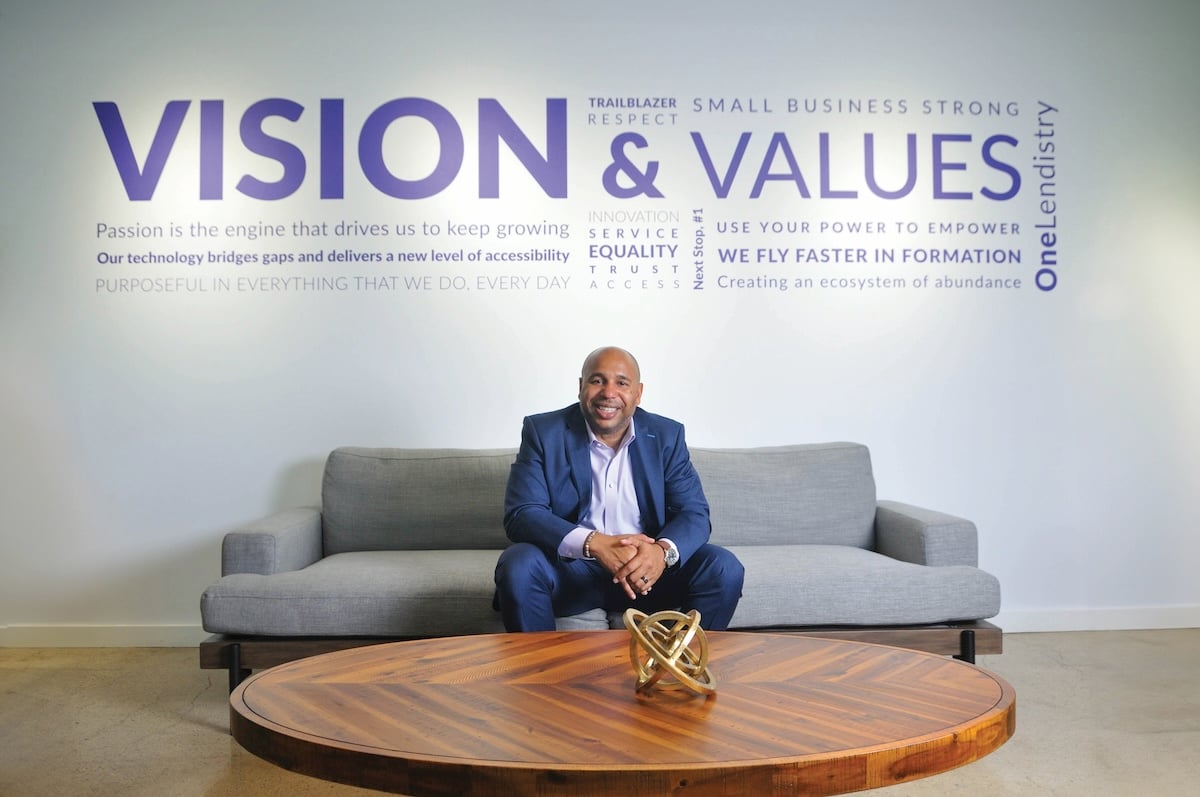
A downtown-based small business lender is at the heart of an ongoing legal effort to test California’s information privacy laws in the age of artificial intelligence.
An October 2024 proposed class action lawsuit alleges that Lendistry, the sole administrator of a state COVID-19 relief grant program, shared applicants’ personal and financial information with third-party AI tools “without adequate disclosure or consent.”
“Everyone who applied went through this privacy violation funnel, where they were asked to connect their bank accounts to a third party who harvested all this data (and) got secret credentials to access their bank account on a continuing basis for an indefinite period of time, even after the grant was funded,” said J.R. Howell, the Santa Monica-based attorney representing the plaintiffs.
The suit asks Lendistry to pay $5,000 per alleged violation in damages to a class of 2,600 businesses. The total judgement the lender could be made to pay remains unclear as discovery is ongoing.
After two years of stop-and-go litigation, the case moved forward last week to a possible resolution.
The lender and the plaintiffs who brought the case on behalf of other businesses that applied for the relief grants have “engaged in substantive settlement discussions,” according to a Nov. 16 joint filing. If they reach an agreement, the parties plan to ask for the court’s preliminary approval by Dec. 18, the filing reads.
Allegations ‘baseless,’ Lendistry says
This comes after Lendistry removed the suit to a federal court in November 2024 and moved to dismiss it. A judge denied that motion, sending the case back to the Los Angeles County Superior Court.
Lendistry has called the plaintiff’s claims “frivolous” and “baseless,” court documents show. The lender has argued, including in a memo this August, that the suit holds no merit because the Long Beach-based accounting firm that led the class action, O&S CPAs & Business Advisors, merged with larger firm BPM Partners before filing – making it ineligible for the small business-focused program in question.
“The entire factual basis underpinning this action is a fraudulent grant application made by a non-existent entity in an attempt to obtain funds from the government,” the memo reads.
In September, a judge decided that argument didn’t hold muster.
“Defendant failed to explain how plaintiffs’ submission of fraudulent SPSL applications would necessarily render plaintiffs’ direct and statutory privacy claims moot,” a Sept. 24 notice of entry of order reads.
In a statement to the Business Journal, a spokesperson for Lendistry wrote that the company “takes seriously its responsibility to protect its customers’ data.”
“We deny the allegations in the complaint and intend to vigorously defend ourselves,” the spokesperson wrote. “Because this matter is in active litigation, we will not comment further.”
Suit alleges data privacy violations
Lendistry, founded in 2015, has deployed roughly $10.5 billion in loans and grants. It was contracted by the state in spring 2023 to administer the Small Business and Nonprofit COVID-19 Supplemental Paid Sick Leave Relief Grant Program, for which it was paid $12.5 million to vet applicants and dole out the grants of up to $50,000.
O&S CPAs & Business Advisors took issue with the systems Lendistry used to collect and process applications. According to their October 2024 complaint, the lender’s bank-verification partner, Plaid Inc., repeatedly accessed their bank accounts.
The proposed suit also claims Lendistry’s AI chatbot provider, Qualified.com Inc., used machine learning to record and analyze conversations with website visitors. Qualified intercepted chats even when it seemed the customer was connected directly with a Lendistry representative, plaintiffs allege.
“Although Qualified states that it never sells user data, the AI trains itself on the communications, which become a part of the product/service itself, and which increases the value of the AI and the company that owns it,” the complaint reads.
Qualified’s public data privacy policy states that the company collects “only the data necessary to use and improve our AI systems … in compliance with applicable laws and regulations.”
Beyond AI model training, O&S’ proposed class action suit doesn’t present other ways in which applicant and website visitor data was used by Plaid and Qualified. That’s because discovery in the case is ongoing, Howell said.
The attorney claimed Lendistry has objected to his requests for further information about the AI tools’ involvement.
“What I’m getting is a stonewall, which is showing me it’s actually smoke, and where there’s smoke, there’s fire,” Howell said.
Automation begs legal questions
As AI systems like the ones described in the proposed class action become ubiquitous, the stack of lawsuits interrogating their data privacy implications is growing.
Courts are actively debating whether consumers should prove a third-party tool actually misused the information it collected or just had the ability to do so. Like the suit Lendistry is defending, many such cases invoke the decades-old California Invasion of Privacy Act, which prohibits intercepting or recording private communications without all parties’ consent.
Last year, a visitor to shoe-seller Converse’s website tried to sue the company, claiming its use of an AI chatbot vendor amounted to wiretapping under CIPA. The 9th Circuit Court of Appeals ruled that just because the vendor could access the messages, a lack of proof that it did so meant Converse couldn’t be held liable.
The decision “made it significantly harder for plaintiffs to weaponize California’s wire- tap law against businesses that rely on modern digital tools,” law firm Fisher Phillips wrote in an analysis.
But the issue isn’t cut-and-dry. Another, similar suit about an AI-powered virtual assistant was allowed to proceed in the U.S. District Court for the Northern District of California in August 2025. The plaintiff claimed that when chatbot provider ConverseNow Technologies Inc. intercepted and recorded her call to Domino’s Pizza, it violated CIPA’s wiretapping and call recording restrictions.
O&S’ complaint is more comparable to the former case, said Aaron McPherson, who runs an advisory focused on financial services and fintechs. The suit relies mostly on AI vendors’ ability to reuse and appropriate applicant data, he said.
“The fact that Plaid retained access to bank accounts after the initial application was complete means that they could have monetized the data. They could have (used it) to market additional products, but I don’t see any claim that they actually did so,” said McPherson, principal at AFM Consulting. “Probably the weakest aspect of the case is that it’s all theoretical, that it could have done it.”
McPherson also argued that Lendistry didn’t do anything out of the ordinary, as most lenders now use AI tools like Plaid when underwriting loans to assess risk using applicants’ financial data. Fintech players like AI lending platform Upstart have come onto the scene, offering loans with little to no human involvement and working with banks and credit unions to automate underwriting.
“What Lendistry did is absolutely typical and routine in the lending industry,” McPherson said. “To say that that’s against the law seems to me (like it) would invalidate all automated lending, and I don’t know that a court is going to be willing to find such a sweeping result.”

