

Faraday Future Intelligent Electric Inc. is sizing up for a key pivot.
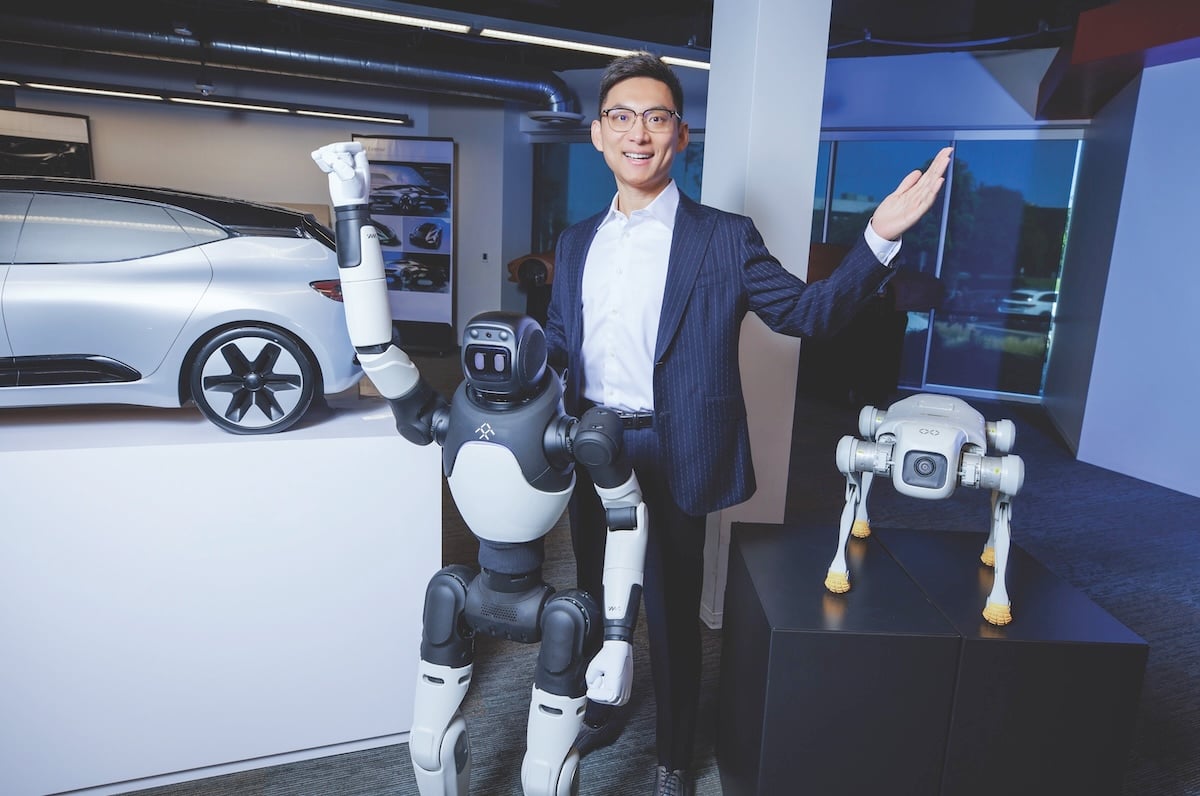
Initially a luxury electric vehicle company, the El Segundo-based manufacturer is taking strides in robotics and embodied artificial intelligence. In February, it debuted three robots – the FF Futurist, FF Master and FX Aegis – at the annual National Automobile Dealers Association Show in Las Vegas. The company also landed a $45 million investment in April to go towards its AI ecosystem, announcing its first partnership with an educational institution that involves a summer camp curriculum around AI robotics for K-12 students.
The company also moved its headquarters from Gardena in May, which according to the company supports the advancement of its strategy and gives it increased access to a strong talent pipeline.
Helming the pivot are two founders who recently assumed key leadership roles at the company: Global Chief Executive YT Jia and Global Executive Chair Jerry Wang.
The Business Journal sat down with Wang to discuss the pivot and how the company plans to stage its comeback in the new phase.
What is it about Faraday Future that made you want to come back and lead the company again as a co-founder?
I’ve been with the company since 2014, since its inception, so I know well about the company, and I feel the opportunity is just great.
First, we are moving forward on the physical AI ecosystem, specifically for robotics as well as automotive. I think it’s still relatively early stage right now, but we’re seeing great momentum moving forward and great opportunity, especially with our own business model that we can really accelerate the deployment of hardware while accelerating our development of our own software, AI and data capabilities. We have an early-mover advantage, and for the automotive that we have been doing for more than 10 years, we learned a lot from the experience.
For the robotics, the approach that we’re doing is relatively asset-light – we’re generating revenue right now, we’re ramping up with a positive gross margin on the product side; so I really see a very good short-mid-long term opportunity, a path to move the company forward and drive a quick break-even from a financial perspective. Those really get me very excited.
What does it mean to have a physical AI company, and what prompted this transition from luxury EVs to a physical robotics space? Also, what are the priorities of the company going forward in that area?
I will not say (it’s a) ‘transition,’ but a smooth upgrade to our strategy.
We build cars and we build robots … those are the physical AI devices.
On the vehicle itself, we are developing our own autonomous driving capability. We have our own operating system based on (the) Android. We have been doing it for 10 years, and there are lots of unique functions, for example, providing live content, video, audio, talk to Zoom or Chat GPT, lots of new innovative experiences behind it. Those are the values added on the automotive – not only building cars but also building the software and ecosystem around it.
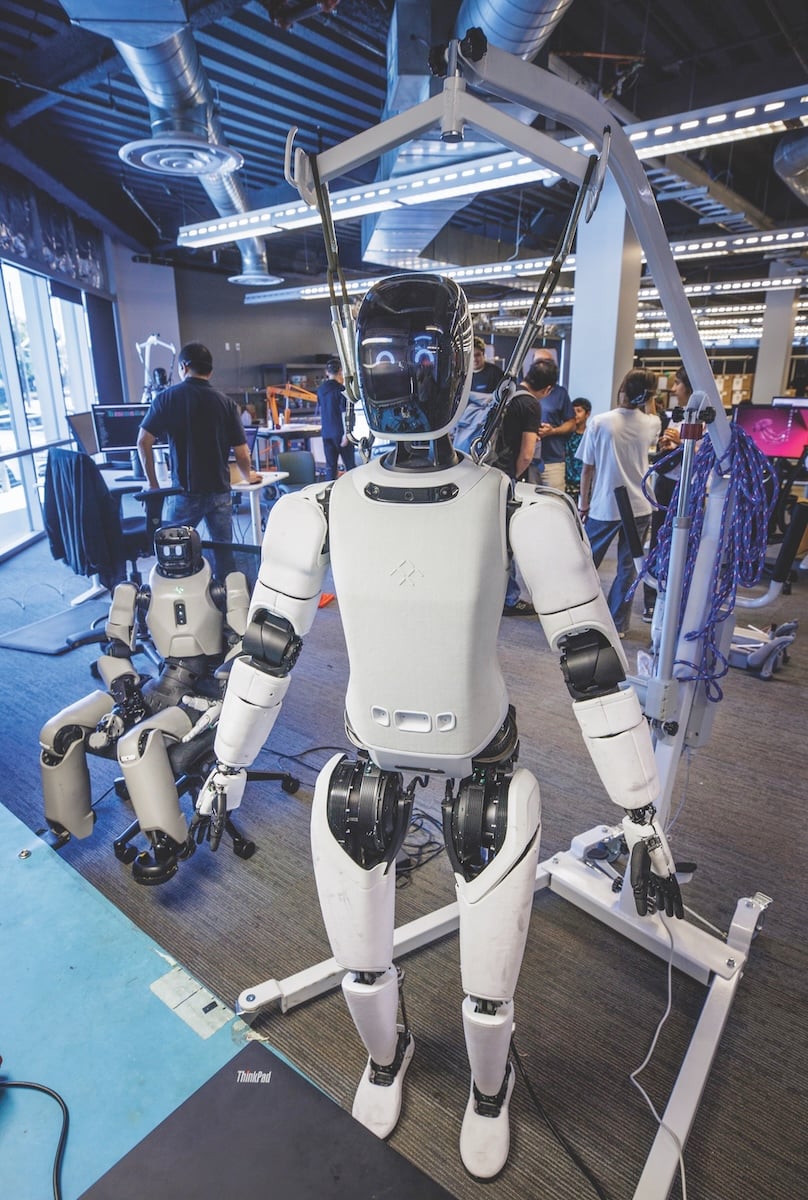
On robotics, that’s more important, given the hardware is not that difficult. There are good robotic companies, especially in Asia, that deploy hardware at scale. But building the software, building the AI, training it (by) using real world data, being able to deploy it into the real-world activity and having it finish tasks, those are very difficult, and it needs a lot of time and focus to develop. That’s the ecosystem we are building. We’re building a positive flywheel like Tesla … the more devices that they deliver, the more data they can generate from their users, and the better (full self-driving) experience will have.
To answer your question – why we’re making this upgrade – it’s pretty natural. Lots of vehicle automotive companies are getting into the robotic field; building cars and building robots are kind of the same. The supply chain is about 80% the same – the AI capability, the operating system, the training and data are kind of the same as well. The manufacturing and compliance or certification is much less complicated for robotics compared to automotive. Definitely there’s heavy competition in the automotive market, but for the robotic market it is just a completely ‘blue ocean’ (of) opportunity.
Where do you see the most demand in physical AI?
First, the demand is very strong for (FX) Super One (vehicles).
People in the U.S. need a (large), good and affordable vehicle … and we’re just in the sweet spot. Sitting in Super One, you can watch movies, watch live sports events, have Zoom calls, talk to AI … and the price is just around half of (the Cadillac) Escalade. That is fulfilling a market demand that has not been fulfilled by the existing product yet. We feel very positive about the market demand (for) the vehicle on the robotic side, for sure.
I think in 10 years there will be more robots compared to human beings. Each human should at least have one robot, if not more. We will reach (an) abundance, probably in the next 10 years or 15 years, meaning that work is optional. There are enough resources generated by all the physical AI products.
There are two sub-streams of our product: one is humanoid and one is quadruped. We’re seeing most near-term opportunities on quadruped because the hardware is relatively mature and the price is relatively low. It’s only a couple-thousand-dollars and the use cases are very clear … one is for education, and second is for safety and surveillance.
For education, taking myself as an example, I have a 3-year-old boy. I already bought him a robot, just for him to have fun and to experience. The younger generation will grow together with those AI devices, robotic devices …we are targeting K-12 education, we come together with courses, with schools, with teachers, with education institutions helping to have kids learn AI, learn programming, learn robotics. We have an app store so they can upload and deploy their developed skill onto it and share revenue and generate some money. Those are the courses we’re developing together with our device … I think that most families would love to give kids those relatively affordable exposures for them to really learn and catch up to the development of this world. We can go very deep. We can even develop courses for Ph.Ds.
FF has expanded into the Middle Eastern market with your October 2025 debut of FX Super One in Dubai. Can you tell me more about your Middle Eastern operations?
We are building both automotive and robotics businesses in the Middle East, but focusing on the robotics, at least in the near term. We see good opportunities, for example, local job creation, local manufacturing and supply chain. That’s really what (the) Middle East countries would love to have.
We’re talking with some security companies in the Middle East. They have, especially for the royal families, their security needs. They indeed have lots of people relatively cheap on labor cost but they’re saying, yeah, the dogs can replace some of them, and later on, the humanoid have good opportunity in those fields as well.
Faraday Future has experienced some bumps in the road since its founding in 2014. There was the previous U.S. Securities and Exchange Commission investigation, and there was a Nasdaq delisting warning. How does your new C-suite plan to turn things around and boost investor confidence?
I would say several points. First, this cadence has the most chance of success. It’s like a standard for early- and fast-growing stage technology companies. What do I mean by standard? The founder and the founding team are in charge. That’s very important. I will not elaborate here, but Tesla, Facebook, Nvidia – those are giants, but still the founders are in charge as (the chief executives) to drive the company forward. The founding teams are really important to grow the company and capture the fast-growing market opportunity. Ninety-nine percent – if not 100% – of the successful technology fast-growing companies are founder driven; that’s the cadence.
The second thing is we’re really glad that we find our way moving forward. Faraday is a small company, (but) even the peak market cap was $4 billion. We made investors and shareholders very good return at that level in 2021 post SPAC merger, but unfortunately there was some governance issue on the board level, we were being pushed aside and (I) was being pushed out. Most of the investors lost a lot of money, so that is showing that how, if you’re not doing it the right way, how damaging it is to relatively immature but fast-growing technology company.
That’s one of the reasons we were struggling. (There is) this great opportunity, but it’s just relatively too difficult from a capital investment perspective, so we’re really glad that we found the opportunity to move forward on the robotics. It’s extremely asset-light compared to automotive, especially with our strategy, doing less on less on hardware, focusing on software, AI, and ecosystem. And we’re generating revenue, we are ramping up on product delivery and we’re generating positive gross margin on our product.
I think those are the great opportunities that we are capturing right now with the right team and with the right structure in place. At the end of the day, it’s about generating revenue and generating profit … How to do that? Build your product, build your technology, spend money wisely. Sell more and operate the company more efficiently.
There is a lot of competition within the EV space, from premium products like Tesla to more affordable Chinese imports. What is the competitive edge for Faraday Future?
I would say the goal is very, very important. It’s not realistic, and it is not our goal, to go peer-to-peer with Tesla in the automotive world. Our goal is not to sell 200,000 vehicles in next year or the following year. That might be realistic for larger companies, but not realistic for Faraday. Again, the goal is to find your niche market opportunity, build a product the market does not have and build it efficiently, ideally with a proven product, and really make money. That’s very important. You need to have at least a 40% contribution margin, if not more, in order to break even. Automotive is really competitive.
As for Faraday, having a realistic goal, developing the product strategy smartly, adding more efficiency and trying to create a healthy margin, and try to break even, generate positive profit margins on each of the vehicles that we sell, that’s very important. And I see it very likely to happen with the FX Super One as an amazing product … people don’t experience good MPV products too much in the U.S., and we’re bringing one here.

Fossil fuel has become more expensive, and people are buying into the EV space. There were also a lot of changes within the industry in general since the Trump administration doubled down on EVs. How would FF strategize to attract investors in this landscape and adapt to the changing landscape?
I would say that by being smart, able to move fast and able to make strategic adjustments quickly. There’s a lot of geopolitical issues and there’s (been) a very good discussion between us and China. That’s very good for companies like Faraday (to) try to be the bridge and build our product with the support of two countries. I would say to act fast, try to adapt, change fast and stick to your core value and try to really create value for your customer, for the market, for the industry, and for the nations that we are working in.
You’re developing a technology to meet peoples’ daily life needs. For example, people need a large, comfortable, affordable car that can carry the whole family out. That’s what we’re building for FX Super One. People need devices to keep them safe, to keep their kids educated, to have fun, to have companions, to learn AI, to learn different languages. You can talk to the (robot) dog to learn history, to learn programming. That’s what we’re building for robotics, and we’re delivering that with U.S. data, U.S. software and with a very affordable price.
If you develop a good product, you’re number one on that market. Tesla is not doing the education, Figure is not doing the education, other robotic companies are not doing the education. As long as you build your product and experience, you’ll be the number one that you can generate revenue and profit. That creates shareholder value.

