

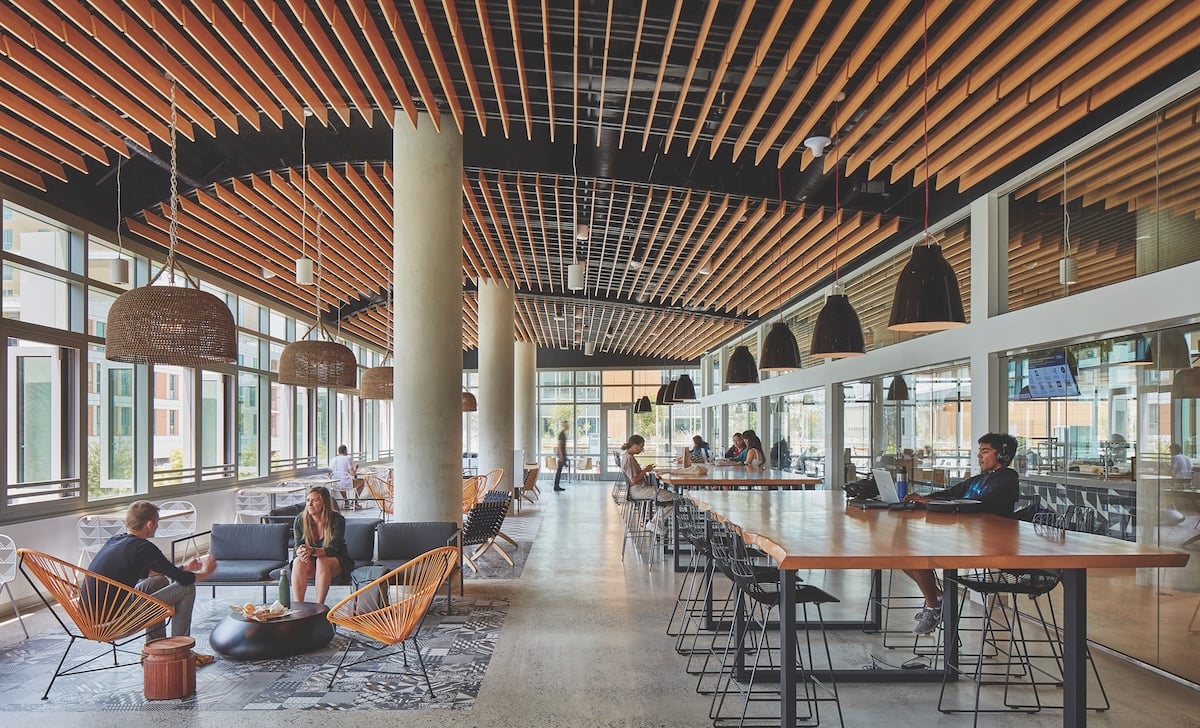
Whether at the hands of state and local mandates or an inkling for altruism, developers, designers and operators are retooling their approaches to achieve greater sustainability throughout the real estate landscape.
For new projects this can mean taking advantage of technologies such as energy modeling and heat mapping to inform design, as well as opting for greener materials, implementing systems to offset waste and finding ways to shorten the construction process.
Scott Hunter, regional director of HKS Architecture’s West Coast practice based in Century City, has found that the “consciousness has changed” in his more than 30 years of working in architecture – as culture along with state policy evolved.
While this has been building for a while, Hunter sees the January wildfires as the nail in the coffin for those still questioning the state of climate change.

“It was kind of an unavoidable reality that suddenly people have to acknowledge and can no longer put their heads in the sand,” Hunter said. “…The pressure on the conversation has changed from doing the right thing to now being an imperative because of where we find ourselves.”
Using modeling to predict energy use and its intensity as well as carbon impact helps drive HKS’s design choices, Hunter said, such as the nature of the facade and the ratio of solid, insulated material versus glass. Daylight analysis also plays a role in ensuring efforts to reduce energy consumption are effective.
For example, if an office building is designed with ceiling-to-floor glass windows, but there’s no thought to what the glare might be, people will end up pulling down the shades and turning on more interior light. This undermines the original intent of using natural light to offset electricity consumption. Similarly, if a building used lower quality glass for this design, which allows heat to travel inside the building, users would have to up their air conditioning.
For local projects, Hunter likes to take advantage of SoCal’s climate as seen with HKS’s design for SoFi Stadium. Because the stadium team did not want an open roof concept in the event of rain, HKS met them in the middle, designing a freestanding roof, which is open on three sides. This roof, which is “more like an umbrella,” Hunter said, eliminates the need to cool the massive stadium. Using the dot frit pattern for the roof instead of making it completely clear, HKS was able to block out about half of the incoming UV to reduce the risk of sunburn for the crowd.
“There was a deliberate idea there to take advantage of our local, beautiful climate and coastal sea breezes of Inglewood,” Hunter said. “…It tells a really great story about who we are, where we are and what Southern California is all about.”
Embodied carbon
Putting aside a carbon-consumption perspective, there’s growing conversation surrounding embodied carbon, which refers to the carbon footprint of the materials used to build and emissions during the construction phase.
In line with the Buy Clean California Act, Caltrans now requires new projects to submit environmental product declarations for concrete use to ensure they are in line with new mandates aimed to reduce carbon emissions.
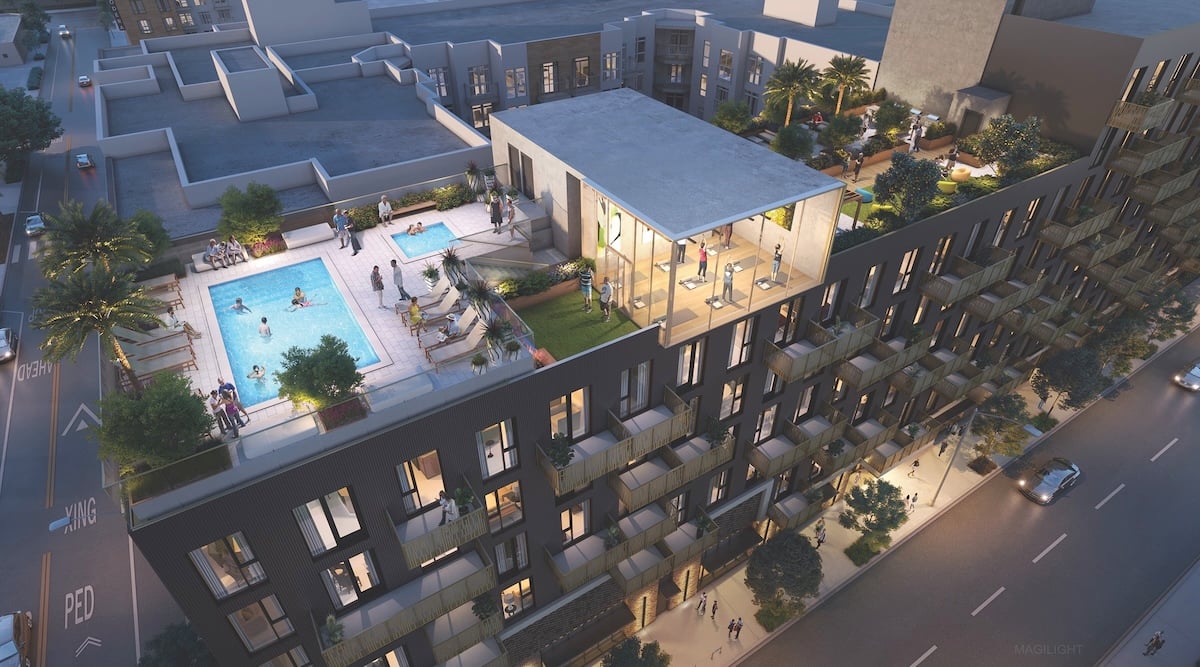
One strategy for lowering embodied carbon is designing buildings to be lighter, said Mark Oberholzer, a principal at KTGY’s downtown L.A. office. This includes using load bearing medal studs instead of large, steel concrete frames. Utilizing mass timber for interior columns is another method which Oberholzer said not only has a nice aesthetic and warm look but also requires less materials than using steel which would have to be covered with a large amount of sheetrock. Methods that make buildings lighter also allow the concrete foundation to be smaller. This works further toward sustainability because concrete has “extremely high-embodied energy,” Oberholzer said.
One project utilizing some of these strategies is a KTGY multifamily development in NorCal, which is implementing a podium made from mass timber instead of concrete and using modular wood construction for the top of the building.
Calling it a “growing market,” Oberholzer said modular doesn’t really save on hard costs for construction but saves time and therefore money. Additionally, because modular building occurs offsite, this method leads to reduced noise pollution, traffic congestion and particle air pollution from dust.
“That creates construction sustainability,” Oberholzer said.
‘Dollar values’
When talking about sustainability in real estate, it’s important to look beyond just what can be done for new construction but also options for making existing buildings greener. From a cost and business perspective, this isn’t always easy to market, said Jack McKee, vice president of origination and account management at PearlX, a grid power systems provider based in Culver City.
“It can’t just be about improving sustainability or improving efficiency,” he said. “You have to deliver true dollar values, and we found that being able to deliver a distributed energy resource like solar with battery backup in some cases was the most impactful way to deliver value to multifamily properties.”
When retrofitting a building, PearlX – which focuses on multifamily properties – leases a building’s roof; and over the course of a few months, implements a new solar-powered energy system, considering energy load demand across the building.
“We allocate load where it makes sense, whether it’s to individual residents or common areas. Then the power they buy from the solar system comes at a discount to what they would have bought from the utility,” McKee said, noting this can generate savings between 5% and 12%.
With increased demand coming from data centers, and even just everyday residential needs, McKee said “fueling the demand for electricity is only going to become a bigger and bigger topic.” Navigating the regulatory environment for existing properties as well as new developments can also be quite onerous.
“Whether you’re a new developer or you’re an existing one, there’s a lot of red tape to untangle,” McKee said. “… We add value just by helping a lot of our clients to navigate that frontier and to be able to get the capital to make the best ROI (return on investment).”
‘Long haul’
Beyond what’s legally required for sustainability, the likelihood for a developer to go the extra mile can be tied to the length they plan to hold onto the property.
In Hunter’s experience, a client viewing a project as more of a transactional commodity as opposed to a long-term investment is probably not going to be as interested in shelling out the capital to deploy more sustainable systems.
“Whereas an institutional client, they’re in it for the long haul… and the long-term operational benefits far outweigh the upfront capital costs on some of the sustainable components,” Hunter said.
Also, while overall still costly, adding sustainable systems during construction is less expensive than doing so a few years down the line, he said.
Within his institutional clients, Hunter said the firm has been able to “make the greatest strides” in sustainable design with universities.
“Because universities are kind of a microcosm of society – people live there, they sleep there, they work there, they play there – it represents a totality of the human experience in many ways,” Hunter said. “So, it becomes a really fertile ground to employ some of these ideas and techniques.”
At UC San Diego, Hunter and the HKS team designed a 1.6 million-square-foot mixed-use campus and implemented an anaerobic digester, which takes food waste and converts it to biofuel.
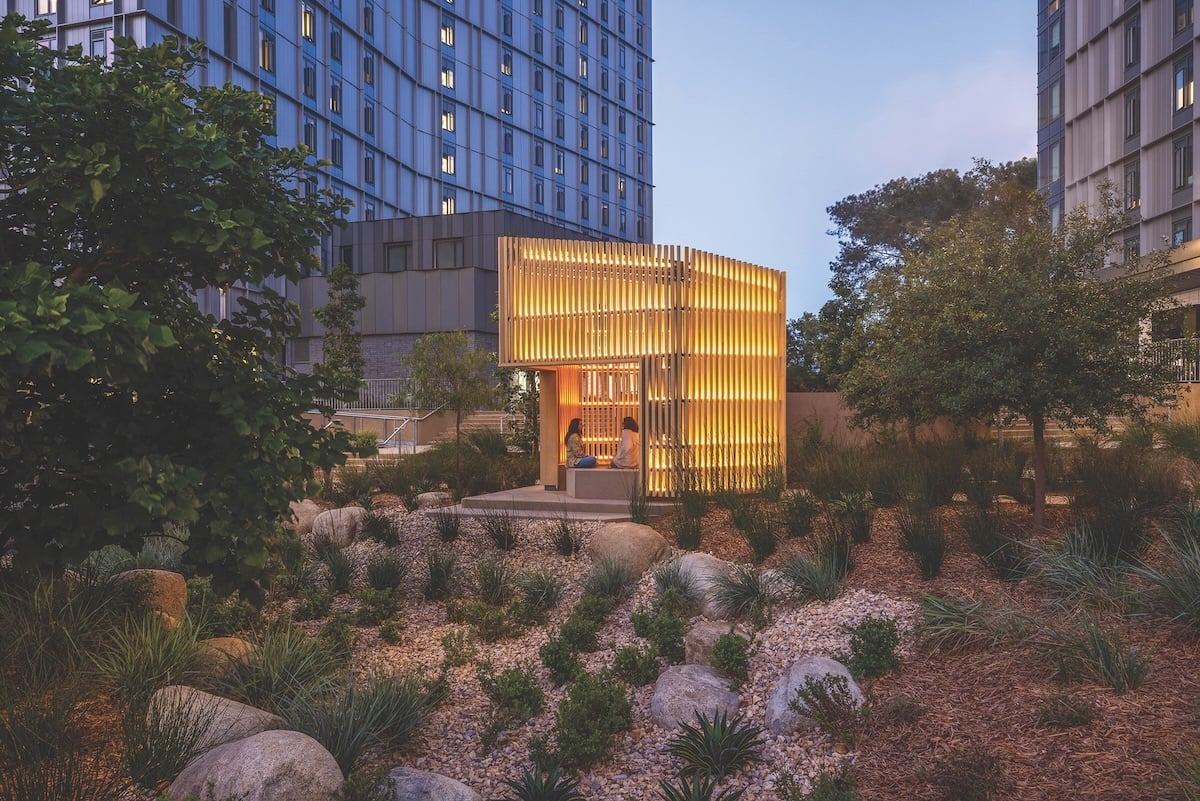
Oberholzer too recognizes institutional developments as being the most open, saying their buildings are “the most cutting edge in terms of equity and also sustainability.” He has also found the municipalities of Pasadena, West Hollywood and Santa Monica to be especially receptive to these design principles in their projects.
While there’s been significant progress in the push toward sustainable building, there continue to be hurdles and issues to weigh such as the electrification of buildings being successful in reducing greenhouse gas emissions but also placing additional pressure on our power grids.
“It’s like climbing a mountain,” Oberholzer said. “The higher you get up, the more you can see and you realize you have a lot further to go and that’s just because of our growing understanding of the impacts of climate change and also the impacts of choices that we make.”
The other challenge in sustainable building is that to make a real, measurable impact in combatting the climate crisis, everyone has to follow these principles. And while California “leads the nation in terms of upping the bar to reduce energy use,” Oberholzer said not everyone is on the same page.
“It doesn’t mean you shouldn’t try. It’s just being cognizant of the reality that you’re working in,” he said. “Change is possible and probable but if you’re forward looking, it’s always less change than you want right now.”
